Introduction
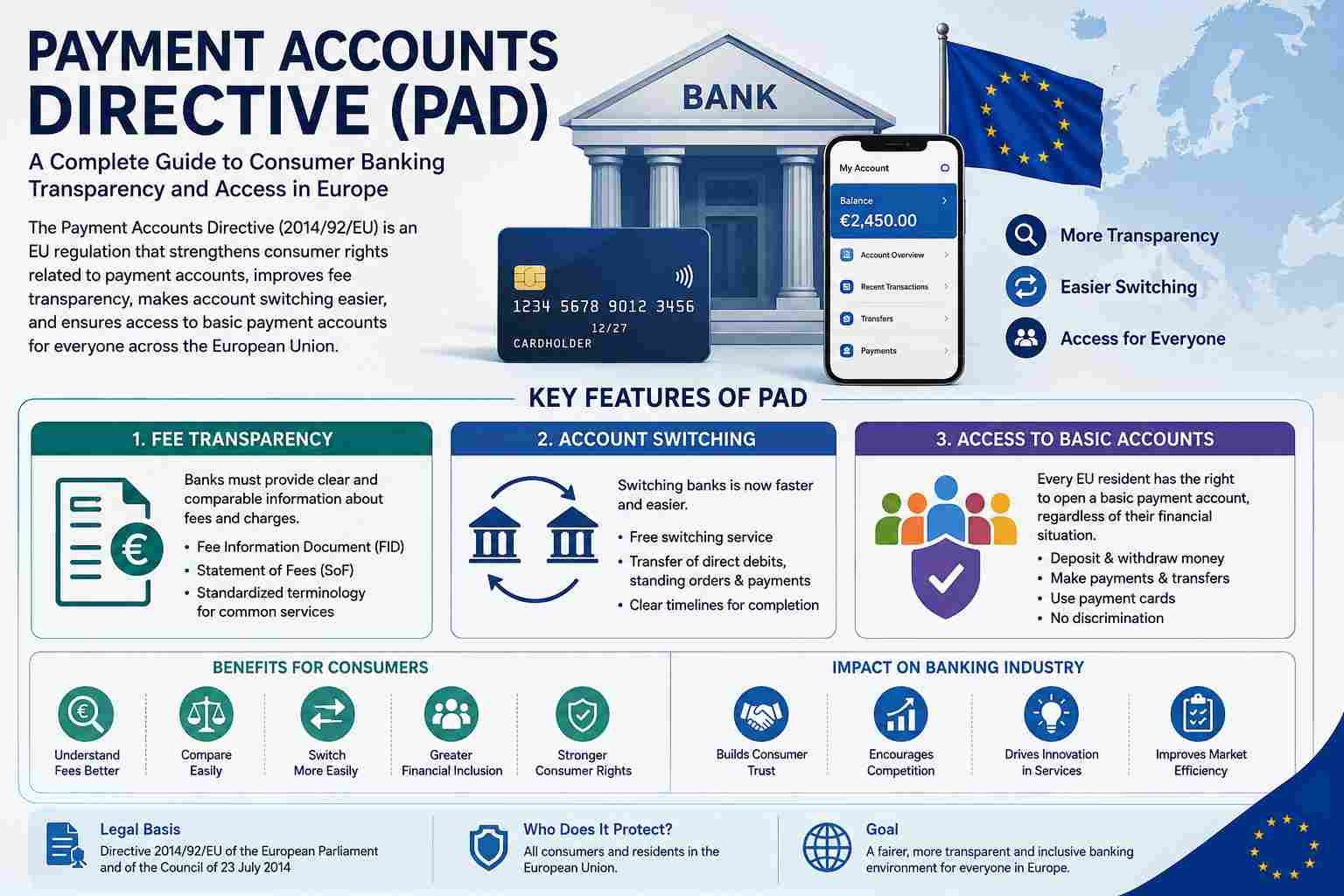
The Payment Accounts Directive (PAD) is one of the most important consumer protection measures introduced by the European Union in the banking sector. Officially known as Directive 2014/92/EU, it was created to improve transparency, comparability, and accessibility of payment accounts across EU member states. Before the directive was implemented, many consumers faced difficulties understanding banking fees, comparing account offers, and opening basic bank accounts, particularly when moving across borders within the European Union.
The modern financial environment depends heavily on access to banking services. Whether receiving a salary, paying bills, shopping online, or conducting everyday financial transactions, consumers need reliable and affordable payment accounts. The Payment Accounts Directive was designed to ensure that consumers can access these essential services fairly and transparently.
This article explores the Payment Accounts Directive in detail, including its objectives, key provisions, benefits, challenges, impact on consumers and financial institutions, and its role in shaping the future of European banking.
Table of Contents
Understanding the Payment Accounts Directive
The Payment Accounts Directive was adopted by the European Parliament and the Council of the European Union in 2014. Its primary purpose is to strengthen consumer rights related to payment accounts and create a more competitive banking market throughout Europe.
The directive focuses on three major areas:
- Fee transparency and comparability
- Easier switching of payment accounts
- Access to basic payment accounts
Together, these measures help consumers make informed decisions while encouraging competition among banks and financial institutions.
Why the Payment Accounts Directive Was Introduced
Before PAD, consumers often struggled with several issues:
- Banking fees were difficult to understand.
- Different banks used different terminology.
- Comparing account costs was complicated.
- Switching banks was time-consuming.
- Some consumers faced barriers when opening bank accounts.
- Financial exclusion affected vulnerable groups.
The European Union recognised that these challenges limited competition and reduced consumer confidence in the banking sector. By introducing standardised rules, regulators aimed to create a fairer and more transparent banking environment.
Main Objectives of the Payment Accounts Directive
The directive was created with several important goals:
Improving Transparency
Consumers should clearly understand the fees associated with their payment accounts. Transparency allows customers to compare products and avoid unexpected charges.
Increasing Competition
When consumers can easily compare services and switch providers, banks must compete more excellently on pricing and service quality.
Promoting Financial Inclusion
Every resident should have access to basic banking services regardless of their financial circumstances.
Facilitating Cross-Border Banking
The European Union promotes free movement of people. Consumers moving between member states should be able to access banking services more easily.
Strengthening Consumer Protection
The directive provides consumers with greater rights and protections when dealing with financial institutions.
What Is a Payment Account?
A payment account is a bank account used for everyday financial transactions.
Examples include:
- Current accounts
- Checking accounts
- Transaction accounts
- Everyday banking accounts
These accounts allow users to:
- Deposit funds
- Withdraw money
- Transfer payments
- Receive salaries
- Pay bills
- Use debit cards
The directive specifically focuses on accounts commonly used for daily financial activities.
Fee Transparency Requirements
One of the most significant features of PAD is its emphasis on fee transparency.
Standardized Fee Information Document (FID)
Banks must provide customers with a fee information document before opening an account.
This document contains:
- Key account fees
- Standardized terminology
- Comparable pricing information
- Common banking services
The purpose is to help consumers compare products across different institutions.
Statement of Fees (SoF)
Banks must also provide an annual statement of fees.
This statement includes:
- Fees charged during the year
- Services used
- Total costs incurred
Consumers gain a clear picture of how much they are paying for banking services.
Common Terminology
Different banks previously used varying terms for identical services.
PAD introduced standardised terminology for common banking services, making comparisons much easier.
Examples include:
- Account maintenance
- Direct debit
- Credit transfer
- Cash withdrawal
- Debit card services
This consistency improves consumer understanding.
Account Switching Services
Changing banks used to be a difficult process for many consumers.
The Payment Accounts Directive introduced rules that simplify account switching.
How Account Switching Works
When a customer decides to switch banks, the receiving bank assists with the process.
The new bank typically helps transfer the following:
- Standing orders
- Direct debits
- Recurring payments
- Incoming transfers
This reduces administrative burdens on consumers.
Switching Timelines
PAD establishes clear timelines for switching services.
Banks must complete the transfer process within specified periods, helping customers avoid delays and disruptions.
Benefits of Easier Switching
Simplified switching encourages:
- Greater competition
- Better customer service
- Lower fees
- Improved banking products
Consumers can move to better providers without significant inconvenience.
Access to Basic Payment Accounts
One of the directive’s most socially significant provisions is access to basic payment accounts.
What Is a Basic Payment Account?
A basic payment account provides essential banking services without unnecessary complexity.
Typically, it allows customers to:
- Deposit money
- Withdraw cash
- Receive payments
- Make transfers
- Use payment cards
- Pay bills
Who Can Open a Basic Payment Account?
EU residents generally have the right to open a basic payment account regardless of the following:
- Financial situation
- Employment status
- Credit history
- Place of residence within the EU
This promotes financial inclusion across member states.
Preventing Financial Exclusion
Access to banking services is increasingly necessary for participation in modern society.
Without a bank account, individuals may struggle to:
- Receive wages
- Pay rent
- Access public services
- Conduct everyday transactions
PAD helps ensure that more people can participate fully in the financial system.
Benefits for Consumers
The Payment Accounts Directive delivers numerous advantages.
Better Fee Understanding
Consumers can clearly see what they are paying and compare costs across providers.
Easier Comparison Shopping
Standardised documents simplify the process of comparing banking products.
Increased Mobility
Consumers moving within the EU can access banking services more easily.
Greater Financial Inclusion
Basic accounts help underserved populations enter the banking system.
Enhanced Consumer Rights
The directive establishes stronger protections and greater transparency.
Reduced Switching Barriers
Consumers can change providers without excessive paperwork or inconvenience.
Benefits for the Banking Industry
Although the directive introduced compliance requirements, it also created advantages for financial institutions.
Increased Consumer Trust
Transparent practices build stronger relationships between banks and customers.
Improved Market Efficiency
Standardisation helps consumers make informed choices.
Competitive Innovation
Banks are encouraged to improve products and services.
Stronger Reputation
Compliance demonstrates commitment to consumer protection.
Challenges in Implementing the Directive
While PAD has delivered substantial benefits, implementation has not been without challenges.
Regulatory Compliance Costs
Banks must invest in:
- Staff training
- Compliance systems
- Documentation updates
- Reporting processes
These costs can be significant, particularly for smaller institutions.
Cross-Border Differences
Although the directive establishes common standards, implementation varies among member states.
Differences in national regulations can create complexity.
Consumer Awareness
Many consumers remain unaware of their rights under PAD.
Greater education and outreach efforts are often needed.
Technological Adaptation
Financial organisations must always update digital systems to maintain compliance and improve service delivery.
Relationship Between PAD and Other EU Financial Regulations
The Payment Accounts Directive works alongside several other important European regulations.
Payment Services Directive (PSD2)
PSD2 focuses on payment services, open banking, and secure electronic payments.
PAD complements PSD2 by emphasising transparency and account accessibility.
General Data Protection Regulation (GDPR)
GDPR governs personal data protection.
Banks must ensure that customer information collected under PAD requirements remains protected.
Anti-Money Laundering Regulations
Financial institutions must balance access to accounts with obligations related to identity verification and fraud prevention.
Impact on Financial Inclusion
One of PAD’s greatest achievements is its contribution to financial inclusion.
Helping Vulnerable Consumers
The directive benefits:
- Low-income individuals
- Unemployed persons
- Migrants
- Students
- Elderly consumers
These groups often face barriers to traditional banking services.
Supporting Economic Participation
Access to a bank account enables individuals to:
- Receive income
- Build financial stability
- Participate in digital commerce
- Access financial products
This contributes to broader economic development.
The Role of Digital Banking
Digital banking has transformed the way consumers interact with payment accounts.
PAD supports this evolution by ensuring transparency regardless of whether services are provided through:
- Traditional branches
- Online banking
- Mobile banking applications
- Digital-first financial institutions
Consumers can compare products more effectively even in increasingly digital markets.
Future Developments and Potential Reforms
Financial services continue to evolve rapidly.
Future developments may include:
Enhanced Digital Comparability Tools
Technology may make account comparisons even easier through online platforms.
Improved Cross-Border Integration
Further harmonisation could strengthen the European single market.
Greater Consumer Education
Educational initiatives may increase awareness of consumer rights.
Expanded Financial Inclusion Measures
Future reforms may address emerging challenges faced by underserved populations.
Integration with Open Banking
PAD principles could work more closely with open banking frameworks to create seamless financial experiences.
Best Practices for Consumers
To maximise the benefits of the Payment Accounts Directive, consumers should:
Review Fee Information Documents
Always examine fees before opening an account.
Compare Multiple Providers
Do not choose the first available option.
Understand Annual Statements
Review yearly fee summaries carefully.
Use Switching Services
Take advantage of bank switching assistance when better options become available.
Learn About Basic Accounts
Individuals facing banking barriers should explore eligibility for basic payment accounts.
Conclusion
The Payment Accounts Directive represents a major milestone in European consumer banking regulation. By improving fee transparency, simplifying account switching, and guaranteeing access to basic payment accounts, the directive has significantly strengthened consumer rights across the European Union.
Its impact extends beyond simple banking reforms. PAD promotes financial inclusion, enhances competition, increases consumer confidence, and supports the broader goal of creating a unified European financial market.
As digital banking continues to evolve and consumer expectations change, the principles underlying the Payment Accounts Directive remain highly relevant. Transparency, accessibility, fairness, and consumer empowerment will continue to shape the future of banking throughout Europe.
For consumers, understanding the rights and protections provided by PAD can lead to better financial decisions and improved access to essential banking services. For financial institutions, compliance with the directive offers an opportunity to build trust and deliver greater value in an increasingly competitive marketplace.
Frequently Asked Questions (FAQs)
1. What is the Payment Accounts Directive (PAD)?
The Payment Accounts Directive is an EU regulation designed to improve fee transparency, simplify account switching, and ensure access to basic payment accounts.
2. When was the Payment Accounts Directive introduced?
The directive was adopted in 2014 as Directive 2014/92/EU and implemented by EU member states in subsequent years.
3. What is a Fee Information Document?
A fee information document is a standardised document that explains account fees in a clear and comparable format.
4. What is a Statement of Fees?
A Statement of Fees is an annual summary showing the fees charged to a customer during the previous year.
5. Can consumers switch bank accounts easily under PAD?
Yes. The directive requires banks to provide account switching services that help transfer payments and direct debits efficiently.
6. What is a basic payment account?
A basic payment account offers essential banking services such as deposits, withdrawals, transfers, and payment card access.
7. Who can open a simple payment account?
Generally, EU residents have the right to access a basic payment account regardless of their financial circumstances.
8. How does PAD improve financial inclusion?
PAD ensures that more people can access basic banking services, reducing barriers to participation in the financial system.
9. Does PAD apply to online banks?
Yes. The directive applies to qualifying payment account providers, including many digital and online banks operating within the EU.
10. Why is fee transparency important?
Fee transparency helps consumers understand costs, compare providers, avoid unexpected charges, and make informed financial decisions.